Showing posts with label Technology. Show all posts

Review:New Message App Initiates To Rival WhatsApp, Telegram With Innovative Features

Business Insider SSA talks to tech entrepreneur and CEO of EQUIIS Technologies, Derek Roga, about his company’s expansion to Nigeria.
Derek also shares insight on how his company, through Flaim app, is planning to rival tech giants in the social media application.
Flaim is a new messaging app that allows users to stay in touch within a community just like WhatsApp and Telegram.
Last month, security hacks on the WhatsApp, known to be end-to-end encryption, raised fresh concerns about the messaging platform. The major breach allowed hackers to install spyware on some users’ phones by simply calling them through the app.
Amid global concerns as Mark Zuckerberg’s WhatsApp and Facebook Messenger continue to differentiate from one another, meet consumer needs, strict sanctions, and follow GDPR regulations, Business Insider SSA by Pulse talked to a tech entrepreneur, Derek Roga, about this development and how his firm, EQUIIS Technologies, is rivalling the tech giants in social media application.
Derek Roga.
In this interview, Derek Roga, CEO of EQUIIS Technologies, also corroborated Telegram’s CEO recent statement on why WhatsApp will continue to face privacy issues.
EQUIIS Technologies’ product, Flaim, is a new messaging app that allows users to stay in touch within a community just like WhatsApp and Telegram.
Here’s an excerpt of the interview which has been edited for clarity sake.
BISSA: Tell us about EQUIIS technologies?
Derek Roga: EQUIIS is headquartered in Zurich, Switzerland, and is one of the global leaders in providing secure, encrypted and auditable messaging solutions for companies, governments, and organizations.
BISSA: Tell us about your plan to enter the Nigerian market?
Derek: We decided to enter the Nigerian market as it is one of the biggest economies in Africa, but also has a large, young and engaged population and a large portion of smartphone users, so we felt it was the right country to start our African launch.
BISSA: One of the most important aspects of mobile apps is data privacy, how would you rate tech giants in this regard?
Derek: Thanks to the media, a lot of bad practices have come to light and we look at what the tech giants are doing as “Data Piracy” instead of “Data Privacy”.
Moreover, we feel that users have not been treated fairly and lured into giving away their data in exchange for free features which has eventually only helped the tech giants and not really benefited the users. With Flaim, each person is the owner of their own data; they should have complete rights to how their data is used or monetized. We do this through our personal data vault.
BISSA: Briefly explain what happened with the recent WhatsApp Hack.
Derek: We don’t have all the details of course, but it is regrettable that an application as popular as WhatsApp didn’t have the measures in place to prevent that.
The fundamental question we ask ourselves is if they were not able to properly protect their own app, how can they assure us they can protect our data. In fact, as recently as April 2019, Facebook the parent company of WhatsApp has hundreds of millions of their subscribers data exposed in the Amazon Cloud.
BISSA: Recently, Telegram’s founder, Pavel Durov, said WhatsApp can never be secure – what do you think about development?
Derek: Almost all messaging and social apps use open source encryption which is well documented as being secure, 100% security is a claim no one should ever make.
The challenge WhatsApp faces is the business model of their parent company is based purely on leveraging people’s data, that in of itself begs the question around the security effectiveness. Apps like Flaim and Telegram are built with security and privacy from the ground up, therefore the inherent architecture assures the security integrity.
BISSA: Flaim, tell us about it and why it should be an option for people?
Derek: We launched Flaim in Nigeria on the 19th of May and by the 22nd of May we had recorded over 100,000 downloads making us the fastest growing app in Nigeria; since then we added another 100,000 downloads and growing on a daily basis.
One of the reasons why it took off so quickly is because we had a campaign where we offered users free data for downloading the app and inviting their friends, and that went viral quickly. Another reason is that we care about privacy and we don’t own the users’ data, nor will we check the user’s data, and that is a game-changing proposition.
Our studies revealed that Nigerians actually care about that as most free apps are built on the business model of aggregating and using user’s data.
BISSA: What essential features will the app offers Nigerians?
Derek: A major value proposal for the user is that Flaim continuously rewards users for being on the platform and being engaged, and we are giving away prizes which range from free data to mobile phones and other goods that come from us and our sponsors, and that is very compelling for most Nigerians who have seen apps eat up their data, without giving anything back.
Derek says the platform also offers users the control over their data and their privacy with features like ‘Do Not Disturb’. The company is also testing a version of Flaim that works on Edge networks, so that rural communities in Nigeria can enjoy VOIP calls.
This interview was published in Pulse’s Business Insider by Ojekunle Aderemi on June 10, 2019.

Nigeria leads Africa’s 7 Highest Internet Using Countries

Access to the Internet is fast becoming a human right in the eyes of millions of people from around the world. This is because the Internet has evolved to a point where people see internet access as vital for them to exercise and enjoy their rights to the freedom of expression and other fundamental human rights such as education.
This view however is one that is enjoyed by people in first world countries where internet access is cheap and readily available.
On the African continent however we face many challenges that need to be overcome before this dream can become a reality. Cost, scalability, power outages and education barriers are just some of the many challenges facing the mass roll out of internet on the continent.
These challenges combined with other economical and sociological barriers see that Africa makes up just 9.1% of the worlds total Internet usage according to Internet World Stats. Although this 9.1 % might look like a lot when compared to the 8.7% of North America or the 0.3% of the Middle East, the fact that there is almost a billion more people living on the African continent than in the Middle East and North America shows just how poor the internet penetration is.
Out of an estimated 1,246,504,865  people living in Africa, just 335,453,374  have access to the internet. This leaves Africa with a 26.9% penetration rate according to Internet World Stats, which when compared to the penetration rates of North America, 88.1%, Europe, 76.7% or even the Middle East at 56.5% and Latin America/ Caribbean at 59.4%, it is clear that the internet access is far from becoming a human right in Africa.
Although these statistics may paint a bleak picture, there are still many African countries who are on the right path and make up the bulk of the internet usage.
Here are Africa’s top 7 Internet Using Countries:
Uganda (Source: Forbes)
7) Uganda
Uganda is a landlocked country in East Africa and is the worlds second most populous landlocked country in the world with an estimated 41,652,938 people living in the country. Uganda has an internet penetration rate of 28.6 % with just 11,924,927 people having access to the internet. The country is Africa’s 7th highest internet using country making up 3.6% of the continents total usage.


Algeria (Source: Forbes)
6) Algeria                                                                                                         Algeria is a North African country which is located on the Mediterranean coast line. There is an estimated 41, 063, 753 people in Algeria but with just 15,000,000 of those people having access to internet the country has an internet penetration rate of 36.5%. Algeria makes up 4.5% of Africa’s total internet usage making it the 6th highest internet using country on the continent.


Morocco (Source: Forbes)
5) Morocco                                                                                                                                  This North African country borders both the Mediterranean sea and the Atlantic Ocean. Morocco has an estimated population of 35,241,418, with an internet penetration rate of 57.3%, meaning 20,207,154 people in Morocco have internet access. The country is Africa’s 5th highest internet using country making up 4.5% of the continents total.


South Africa (Source: Forbes)
4) South Africa                                                                                                                          Located on the Southern tip of the continent, South Africa has an estimated population of 55,436,360. Out of this total population 28, 580, 290 have access to the internet leaving the country with an internet penetration rate of 51.6%. South Africa contributes 8.5% to Africa’s total internet usage making the it Africa’s 4th highest internet using country.


Kenya (Source: Forbes)
3) Kenya                                                                                                                                           Kenya is an East African situated with a coastline on the Indian Ocean. There is an estimated 48,466,928 million people living in Kenya, with 31,985,048 of country’s population being able to access the internet, Kenya has a internet penetration rate of 66%. This leads Kenya to contribute 9.5% of the continents total internet usage and thus making it Africa’s 3rd highest internet using country.


Kenya (Source: Forbes)
2) Egypt                                                                   North African country Egypt has an estimated population of 95,215,102. Out of this total population just 34,800,000 have access to the internet leaving the country with an internet penetration rate of 36.5%. Egypt is Africa’s 2nd highest internet using country making up 10.4% of the continents total.


Nigeria (Source: Forbes)
1) Nigeria                                                                                                                                      West African country Nigeria is Africa’s most populated country with an estimated  191,835,936 living in Nigeria. The country has an internet penetration rate of 47.9% as 91,880,032 of the country’s population has access to the internet. Nigeria is ranked as African’s highest internet using country, making up 27.4% of the continents total usage.

IT innovation: Nigeria spends $70bn to support start-ups

Adebayo-Shittu, Communications Minister
The Minister for Communications, Barr. Adebayo Shittu, has said that the only way Nigeria can get out of the economic woods is to embrace innovations in information and communications technology, ICT.


Shittu who was a guest at the just concluded ICT Start-up Ecosystem stakeholders meeting organized by National Information Technology Development Agency, NITDA, in Abuja, said that is why Nigeria has spent a total $70 billion to support IT start-ups since 2001. 

The Minister however said this culture has to be consistent and better improved for Nigeria to compete in the global stage. 

“Government has no option but to support the innovators and entrepreneurs in order to survive and create jobs to the teaming population. 

The entire civil service is made up of only 1.5 million Nigerians, yet we have a population of about 180 million. 

That means that government has barely been able to provide one percent of direct jobs for the population. ‘‘

Whether we like it or not, since government cannot provide jobs for everybody, government must create enabling environment for everybody to responsibly be engaged.

 If we can appreciate what is happening in other climes, it means Nigeria’s government has a primary duty, not only to create the enabling environment for innovation and entrepreneurship to thrive, but we must amass positive support and collaboration for innovators and entrepreneurs to be properly engaged, so that they can contribute to national development. 

That is why is imperative for us as a government to support your efforts in innovation and entrepreneurship. You can be rest assured that whatever you want to do, we as a government are ready to do it,’’ he said. In his presentation, Barrister Kasim Sodanji of the Office for Nigerian Content Development in ICT, ONC, an arm of NITDA, corroborated the minister’s claim that Nigeria has spent about $70 billion to support IT start-ups since 2001. 

Sodanji, who spoke on National Start-up Innovation Fund, said government had intervened in many sectors of the economy, but has not made appreciable intervention in the IT sector.

 “Nigeria has less venture capital with less than 100 agent investors that get access in Nigeria. For this country to compete globally in the IT sector government must invest more to justify the objective. Nigeria has intervened in many sectors. 

The intervention Nigeria has had over the last 15 years is N1.7 trillion.  But this money has gone into various other areas of the economy.” We have not intervened in the ICT sector the way we should, despite the fact that ICT is the third in contribution to GDP. 

Millions of jobs are lost due to the poor intervention. ‘‘For start-ups to survive, government must look for a way to catalyze private sector funds so that we can have funds for long term ICT funding for start-ups in Nigeria. 

This fund is one that must compete globally so that other people can comfortably key into it.’’ Director General, NITDA, Isa Pantami, during his address said the workshop is meant for ideas sharing among innovators and entrepreneurs because of the indispensability of IT in job creation. His words; “The ICT sector is a catalyst in addressing the needs and interests of many other sectors. 

The growth rate of tech innovators in ICT has accelerated dramatically and this encompasses more diverse players than ever before. 

Technology increases productivity, therefore, when people share access in form of collaboration they build stronger business strategy for establishing large successful firms in the business ecosystem.”


Tech Tent: 5G, Huawei and a question of trust

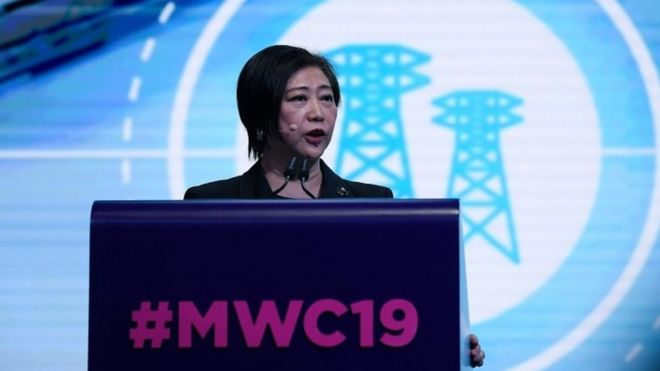
Chua Sock Kooong, from Singtel, giving a keynote
Image captionMobile World Congress kicked off this week in Barcelona with a bunch of keynotes and lots of new phones
It was the star turn of Mobile World Congress with a folding phone that was 5G ready. But on this week's Tech Tent we ask should the mobile industry trust Huawei?
When I first attended the giant Barcelona mobile gathering more than a decade ago, it was the likes of Nokia, Samsung and even Microsoft, with its Windows phones, which made the headlines.
Podcast available now
Huawei was an obscure Chinese telecoms equipment maker that occupied a large shed on the showground but struggled to generate much interest from the media.
This year the company's press conference on Sunday was the hottest ticket, with swarms of journalists queuing up for an hour to get in.
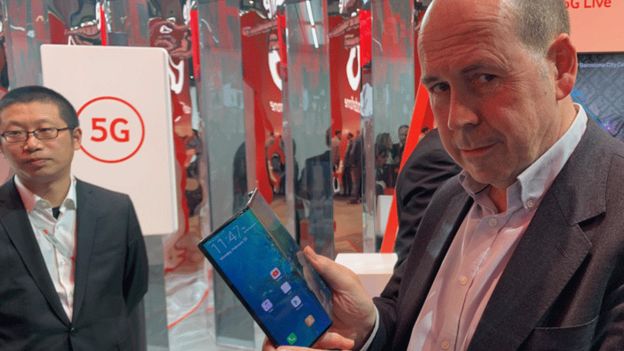
Rory Cellan-Jones with Huawei's Mate X
Image captionRory gets his hands on a Huawei folding phone and he didn't break it, much to the firm's relief
At the heart of the loud and slightly clunky presentation was the Huawei Mate X, a phone with a foldable screen that the presenter suggested was bigger and better in every way than the Samsung Galaxy Fold, unveiled a few days earlier.
Despite the fact that at $2,600 (£1,960) it was also even more expensive, most analysts agreed that it trumped the Samsung device. I even managed to get my hands on it the following day though the Huawei executive who produced it out of an inside jacket pocket seemed terrified that I might fold it too far and break it.
But if Huawei was rather more open about its new device than Samsung, there was one issue that was firmly off the agenda, The company did not want to talk about the allegations from the United States that it poses a security threat to the new 5G networks.
US government officials were in Barcelona to press home their message that Huawei owes its allegiance to the Chinese Communist Party and should not be trusted by the mobile operators to provide secure equipment for their new networks.
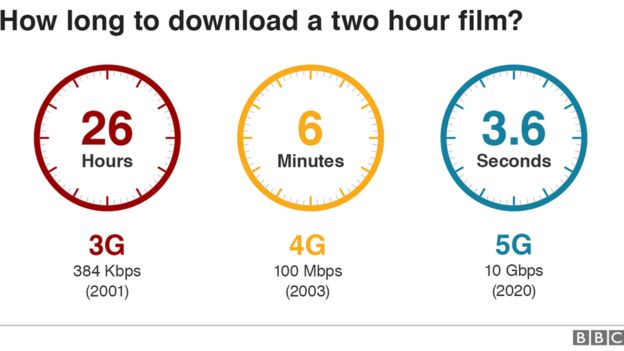
Graphic showing speeds of 3G, 4G and 5G
Image captionWhat can 5G do?
The Europeans were keen to be seen as sharing some of those concerns. Security consultant David Rogers tells Tech Tent the operators do realise that they may have become over-reliant on cheap Huawei equipment: "The mobile networks have paid bottom dollar in a lot of cases for certain network equipment and that equipment might not be the same quality as other providers and now they're reaping what they've sown."
But the operators also appear to share Huawei's view that the United States has failed to provide evidence of any wrongdoing in the form of backdoors in its equipment.
The consensus is that all providers, whether from China or elsewhere, need to be subjected to greater scrutiny as 5G networks are rolled out and become embedded in vital infrastructure.
With 5G demos everywhere across the vast halls of Mobile World Congress, it was apparent how central this technology is to this industry's ambitions and how important security will be.
We saw how in Toronto 5G sensors have been installed across the water system to identify water pressure and improve efficiency by spotting any leaks. A team from the UK's University of Surrey showed off a 5G-enabled McLaren sports car which could receive live information about other cars and hazards from sensors mounted by the roads.
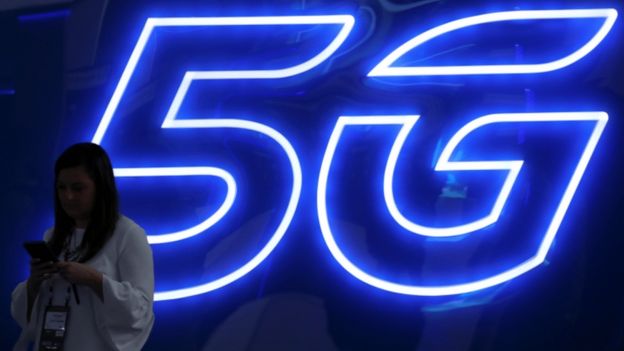
5G graphic
Image caption5G could be vital for smart city services but can the operators make money?
In both cases, you would want to be certain that the networks and the devices connected to them could not be hacked.
Along with all these security concerns, the operators and manufacturers face another nagging question - can they actually make money from 5G? As we emerged from the event where the Chinese firm Xiaomi had unveiled a 5G handset for $679, I ran into the leading mobile analyst Ben Wood of CCS Insight.
He described that price as "eye-popping" - and he meant low not high. With the Chinese firm offering a state-of-the-art 5G handset at a price way below Samsung and Apple's 4G flagships, Ben reckons middle market manufacturers like Sony and LG will struggle to make any kind of margin.

5G looks certain to bring another wave of disruption to the mobile industry. And whatever the issues of trust and security, Chinese firms like Xiaomi and Huawei look likely to prosper.

Tech Tent: 5G, Huawei and a question of trust

Chua Sock Kooong, from Singtel, giving a keynote
Image captionMobile World Congress kicked off this week in Barcelona with a bunch of keynotes and lots of new phones
It was the star turn of Mobile World Congress with a folding phone that was 5G ready. But on this week's Tech Tent we ask should the mobile industry trust Huawei?
When I first attended the giant Barcelona mobile gathering more than a decade ago, it was the likes of Nokia, Samsung and even Microsoft, with its Windows phones, which made the headlines.
Podcast available now
Huawei was an obscure Chinese telecoms equipment maker that occupied a large shed on the showground but struggled to generate much interest from the media.
This year the company's press conference on Sunday was the hottest ticket, with swarms of journalists queuing up for an hour to get in.
Rory Cellan-Jones with Huawei's Mate X
Image captionRory gets his hands on a Huawei folding phone and he didn't break it, much to the firm's relief
At the heart of the loud and slightly clunky presentation was the Huawei Mate X, a phone with a foldable screen that the presenter suggested was bigger and better in every way than the Samsung Galaxy Fold, unveiled a few days earlier.
Despite the fact that at $2,600 (£1,960) it was also even more expensive, most analysts agreed that it trumped the Samsung device. I even managed to get my hands on it the following day though the Huawei executive who produced it out of an inside jacket pocket seemed terrified that I might fold it too far and break it.
But if Huawei was rather more open about its new device than Samsung, there was one issue that was firmly off the agenda, The company did not want to talk about the allegations from the United States that it poses a security threat to the new 5G networks.
US government officials were in Barcelona to press home their message that Huawei owes its allegiance to the Chinese Communist Party and should not be trusted by the mobile operators to provide secure equipment for their new networks.
Graphic showing speeds of 3G, 4G and 5G
Image captionWhat can 5G do?
The Europeans were keen to be seen as sharing some of those concerns. Security consultant David Rogers tells Tech Tent the operators do realise that they may have become over-reliant on cheap Huawei equipment: "The mobile networks have paid bottom dollar in a lot of cases for certain network equipment and that equipment might not be the same quality as other providers and now they're reaping what they've sown."
But the operators also appear to share Huawei's view that the United States has failed to provide evidence of any wrongdoing in the form of backdoors in its equipment.
The consensus is that all providers, whether from China or elsewhere, need to be subjected to greater scrutiny as 5G networks are rolled out and become embedded in vital infrastructure.
With 5G demos everywhere across the vast halls of Mobile World Congress, it was apparent how central this technology is to this industry's ambitions and how important security will be.
We saw how in Toronto 5G sensors have been installed across the water system to identify water pressure and improve efficiency by spotting any leaks. A team from the UK's University of Surrey showed off a 5G-enabled McLaren sports car which could receive live information about other cars and hazards from sensors mounted by the roads.
5G graphic
Image caption5G could be vital for smart city services but can the operators make money?
In both cases, you would want to be certain that the networks and the devices connected to them could not be hacked.
Along with all these security concerns, the operators and manufacturers face another nagging question - can they actually make money from 5G? As we emerged from the event where the Chinese firm Xiaomi had unveiled a 5G handset for $679, I ran into the leading mobile analyst Ben Wood of CCS Insight.
He described that price as "eye-popping" - and he meant low not high. With the Chinese firm offering a state-of-the-art 5G handset at a price way below Samsung and Apple's 4G flagships, Ben reckons middle market manufacturers like Sony and LG will struggle to make any kind of margin.

5G looks certain to bring another wave of disruption to the mobile industry. And whatever the issues of trust and security, Chinese firms like Xiaomi and Huawei look likely to prosper.

American companies must step up their efforts, or get left behind.


World’s first 5G train station


By September 2019, Shanghai’s Hongqiao railway station will become the first terminal in the world to offer super-fast 5G mobile network coverage. The station’s current 4G network has become too slow to serve the up to 300,000 passengers each day who pass through the major terminal in the western suburbs of the Chinese metropolis. When online in a few months, passengers will be able to download a 2GB high-definition movie in just 20 seconds, or be able to easily connect to robots serving food and beverages in the station. Considered a major advance in application of 5G technology, the project is a collaboration between Huawei and China Mobile Shanghai. Plugging 5G coverage at Hongqiao is a step towards the commercial use of 5G tech in China, aimed to be completed in 2020.

Samsung introduces a new line of premium smartphones: Galaxy S10

Image result for galaxy foldWith three unique devices, the Galaxy S10 line is engineered to meet the distinct needs of today’s smartphone market, so consumers can do more of what they love. Each device delivers a next-generation experience in the categories consumers care about most: ground-breaking innovations in display, camera and performance.


As testament to a decade of innovations, Galaxy S10 is designed for those who want a premium smartphone with powerful performance and sets the stage for the next generation of mobile experiences. For consumers looking for a supercharged device, Galaxy S10+ takes every spec – from display, to camera, to performance – to the next level. Galaxy S10e is built for those who want all the premium essentials in a compact package on a flat screen.

“Since its launch ten years ago, the Galaxy S series has stood for premium innovation – offering consumers an incredible experience, and the ability to find the device that’s right for them,” Dudu Mokholo, Chief Marketing Officer at Samsung Central Africa. “Galaxy S10 builds on that incredible legacy, and delivers breakthrough display, camera, and performance innovations. With three premium devices, each built for a unique consumer in mind, Samsung is leveraging a decade of industry leadership to usher in a new era of smartphone technology.”

The technology giant is also unfolding the future with a whole new mobile category by introducing the Samsung Galaxy Fold.

The highly anticipated Galaxy Fold is a new foldable device that features the world’s first 7.3-inch Infinity Flex Display, which folds into a compact device with a cover display. Galaxy Fold offers a powerful new way to multitask, watch videos, play games, and more – bringing to life new experiences and possibilities years in the making.

“Today, Samsung is writing the next chapter in mobile innovation history by changing what’s possible in a smartphone. Galaxy Fold introduces a completely new category that unlocks new capabilities never seen before with our Infinity Flex Display.” said DJ Koh, President and CEO of IT & Mobile Communications Division, Samsung Electronics. “We created Galaxy Fold for those that want to experience what a premium foldable device can do, beyond the limitations of a traditional smartphone.”

Galaxy Fold is in a category of its own. It delivers a new kind of mobile experience allowing users to do things they couldn’t do with an ordinary smartphone. Users now have the best of both worlds; a compact device that unfolds to reveal Samsung’s largest-ever smartphone display.

Galaxy Fold will be released unto the market in the second quarter of 2019.