Biden versus Trump. Some speculate that the future of the republic hinges on the outcome of the next election. But for smart investors, it doesn't really matter who wins.
Conventional wisdom says that those liberal Dems are generally bad for the economy and the stock market because of their big-government tendencies, while fiscally conservative Republicans are good. This widely accepted belief is actually fake news if you look at data going back to the end of World War II.
“Stock markets do perform better under Democrats than under Republicans. That’s a well-known fact, but it does not imply cause and effect,” says Jeremy Siegel, the Russell E. Palmer Professor of Finance at the Wharton School of the University of Pennsylvania. From 1952 through June 2020, annualized real stock market returns under Democrats have been 10.6% compared with 4.8% for Republicans.
With the 2020 election less than four months away, some investors are fretting about the pros and cons of a Trump vs. Biden presidency. A Democratic sweep would almost certainly mean a rollback of Trump’s massive corporate tax cut (a negative for stocks), but additional economic stimulus (which the market apparently loves despite deficit implications) and stability on the China trade front would be a big positive.
PRESIDENTIAL PERFORMANCE
Which presidents have delivered the best stock returns? So far Democrats are dominating.
How does personality develop? According to the famous psychoanalyst Sigmund Freud, children go through a series of psychosexual stages that lead to the development of the adult personality. His theory described how personality developed over the course of childhood. While the theory is well-known in psychology, it has always been quite controversial, both during Freud's time and in modern psychology.
An Overview of the Psychosexual Stages
Illustration by Joshua SeongSo how exactly do the psychosexual stages work? Freud believed that personality developed through a series of childhood stages in which the pleasure-seeking energies of the id become focused on certain erogenous areas. An erogenous zone is characterized as an area of the body that is particularly sensitive to stimulation. During the five psychosexual stages, which are the oral, anal, phallic, latent and genital stages, the erogenous zone associated with each stage serves as a source of pleasure.
This psychosexual energy, or libido, was described as the driving force behind behavior. Psychoanalytic theory suggested that personality is mostly established by the age of five. Early experiences play a large role in personality development and continue to influence behavior later in life.
So what happens during each stage? What if a person fails to progress through a stage completely or favorably? If these psychosexual stages are completed successfully, a healthy personality is the result.
If certain issues are not resolved at the appropriate stage, fixations can occur. A fixation is a persistent focus on an earlier psychosexual stage. Until this conflict is resolved, the individual will remain "stuck" in this stage. For example, a person who is fixated at the oral stage may be over-dependent on others and may seek oral stimulation through smoking, drinking, or eating.
The Oral Stage
Age Range: Birth to 1 Year Erogenous Zone: Mouth
During the oral stage, the infant's primary source of interaction occurs through the mouth, so the rooting and sucking reflex is especially important. The mouth is vital for eating, and the infant derives pleasure from oral stimulation through gratifying activities such as tasting and sucking.
Because the infant is entirely dependent upon caretakers (who are responsible for feeding the child), the child also develops a sense of trust and comfort through this oral stimulation.
The primary conflict at this stage is the weaning process--the child must become less dependent upon caretakers. If fixation occurs at this stage, Freud believed the individual would have issues with dependency or aggression. Oral fixation can result in problems with drinking, eating, smoking, or nail biting.
The Anal Stage
Age Range: 1 to 3 years Erogenous Zone: Bowel and Bladder Control
During the anal stage, Freud believed that the primary focus of the libido was on controlling bladder and bowel movements. The major conflict at this stage is toilet training--the child has to learn to control his or her bodily needs. Developing this control leads to a sense of accomplishment and independence.
According to Freud, success at this stage is dependent upon the way in which parents approach toilet training. Parents who utilize praise and rewards for using the toilet at the appropriate time encourage positive outcomes and help children feel capable and productive. Freud believed that positive experiences during this stage served as the basis for people to become competent, productive, and creative adults.
However, not all parents provide the support and encouragement that children need during this stage. Some parents instead punish, ridicule or shame a child for accidents.
According to Freud, inappropriate parental responses can result in negative outcomes. If parents take an approach that is too lenient, Freud suggested that an anal-expulsive personality could develop in which the individual has a messy, wasteful, or destructive personality. If parents are too strict or begin toilet training too early, Freud believed that an anal-retentive personality develops in which the individual is stringent, orderly, rigid, and obsessive.
The Phallic Stage
Age Range: 3 to 6 Years Erogenous Zone: Genitals
Freud suggested that during the phallic stage, the primary focus of the libido is on the genitals. At this age, children also begin to discover the differences between males and females.
Freud also believed that boys begin to view their fathers as a rival for the mother’s affections. The Oedipus complex describes these feelings of wanting to possess the mother and the desire to replace the father. However, the child also fears that he will be punished by the father for these feelings, a fear Freud termed castration anxiety.
The term Electra complex has been used to describe a similar set of feelings experienced by young girls. Freud, however, believed that girls instead experience penis envy.
Eventually, the child begins to identify with the same-sex parent as a means of vicariously possessing the other parent. For girls, however, Freud believed that penis envy was never fully resolved and that all women remain somewhat fixated on this stage. Psychologists such as Karen Horneydisputed this theory, calling it both inaccurate and demeaning to women. Instead, Horney proposed that men experience feelings of inferiority because they cannot give birth to children, a concept she referred to as womb envy.
The Latent Period
Age Range: 6 to Puberty Erogenous Zone: Sexual Feelings Are Inactive
During this stage, the superego continues to develop while the id's energies are suppressed. Children develop social skills, values and relationships with peers and adults outside of the family.
The development of the ego andsuperego contribute to this period of calm. The stage begins around the time that children enter into school and become more concerned with peer relationships, hobbies, and other interests.
The latent period is a time of exploration in which the sexual energy repressed or dormant. This energy is still present, but it is sublimated into other areas such as intellectual pursuits and social interactions. This stage is important in the development of social and communication skills and self-confidence.
As with the other psychosexual stages, Freud believed that it was possible for children to become fixated or "stuck" in this phase. Fixation at this stage can result in immaturity and an inability to form fulfilling relationships as an adult.
The Genital Stage
Age Range: Puberty to Death Erogenous Zone: Maturing Sexual Interests
The onset of puberty causes the libido to become active once again. During the final stage of psychosexual development, the individual develops a strong sexual interest in the opposite sex. This stage begins during puberty but last throughout the rest of a person's life.
Where in earlier stages the focus was solely on individual needs, interest in the welfare of others grows during this stage. If the other stages have been completed successfully, the individual should now be well-balanced, warm, and caring. The goal of this stage is to establish a balance between the various life areas.
Unlike the many of the earlier stages of development, Freud believed that the ego and superego were fully formed and functioning at this point. Younger children are ruled by the id, which demands immediate satisfaction of the most basic needs and wants. Teens in the genital stage of development are able to balance their most basic urges against the need to conform to the demands of reality and social norms.
Evaluating Freud's Psychosexual Stage Theory
Freud's theory is still considered controversial today, but imagine how audacious it seemed during the late 1800s and early 1900s. There have been a number of observations and criticisms of Freud's psychosexual theory on a number of grounds, including scientific and feminist critiques:
The theory is focused almost entirely on male development with little mention of female psychosexual development.
His theories are difficult to test scientifically. Concepts such as the libido are impossible to measure, and therefore cannot be tested. The research that has been conducted tends to discredit Freud's theory.
Future predictions are too vague. How can we know that a current behavior was caused specifically by a childhood experience? The length of time between the cause and the effect is too long to assume that there is a relationship between the two variables.
Freud's theory is based upon case studies and not empirical research. Also, Freud based his theory on the recollections of his adult patients, not on actual observation and study of children.
How Does Homosexuality Fit In to Freud's Theory?
Another criticism of the psychosexual stages is that the theory focuses primarily on heterosexual development, and largely ignores homosexual development.
So how exactly did Freud explain the development of sexual preferences?
Freud's theory suggested that heterosexual preferences represent the "normal" outcome of development and suggested that homosexual preferences represented deviation of this process. Freud's own viewpoints on homosexuality varied, at times expressing biological explanations and at other times social or psychological explanations for sexual preferences.
Unlike many thinkers of his time, Freud was unconvinced that homosexuality represented a pathology. He also believed that attempts to alter a person's sexuality were usually futile and often harmful.
In a famous 1935 letter to a mother who had written him to ask that he treat her homosexual son, Freud wrote that while he believed homosexuality was not advantageous, it was certainly not a vice or something to be ashamed of. Freud wrote, "...it cannot be classified as an illness; we consider it to be a variation of the sexual function, produced by a certain arrest of sexual development."
While Freud's theory implied that homosexuality was a deviation in normal psychosexual development, many contemporary psychologists believe that sexual orientation is largely influenced by biological factors. A Word From Verywell
While few people are strong proponents of Freud's theory of psychosexual development today, his work made important contributions to our understanding of human development. Perhaps his most important and enduring contribution was the idea of that unconscious influences could have a powerful impact on human behavior.
Freud's theory also stressed the importance of early experiences on development. While experts continue to debate the relative contributions of early versus later experiences, developmental experts recognize that the events of early life play a critical role in developmental process and can have lasting effects throughout life.
One important thing to note is that contemporary psychoanalytic theories of personality development have incorporated and emphasized ideas about internalized relationships and interactions and the complex ways in which we maintain our sense of self into the models that began with Freud.
In the past, there has been considerable controversy surrounding the scientific study of love. A lot of people view love as mysterious and unquantifiable. Here are four common questions about the role of love in psychology.
1. How Does the Study of Love Differ From Other Topics?
During the 1970s, a U.S. Senator named William Proxmire gave psychologist Elaine Hatfield what he called "the Golden Fleece Award." Essentially, he accused her of wasting taxpayer dollars on useless research on love. At the time, many people agreed with him.
Since then, research on love has helped change how we view parenting, education, and child development. There is a lot of variability in how love is studied. Harry Harlow's famous attachment experiments involved depriving infant monkeys of all social contact, which demonstrated how devastating a lack of love can be to normal development. Today, most love researchers utilize self-report surveys to gather information on attitudes, perceptions, and reactions to love.
2. Which Model of Love Is Mostly Widely Accepted?
Perhaps the best-known model today is Sternberg's Triangular Theory of Love. The reason this theory gets a lot of attention is that it combines many of the elements found in earlier theories of love. According to Sternberg, there are three essential elements of love: intimacy, passion, and commitment.
A relationship built on only one of these elements is generally considered weak, while one built on two or more elements is much more lasting. For example, a combination of passion and intimacy would be what Sternberg refers to as "passionate love." A combination of intimacy, passion, and commitment forms what is known as "consummate love."
3. Are There Studies Compaing Parent-Child Love to Future Romantic Relationships?
Yes. There has been quite a bit of research in this area recently. Traditional belief has suggested that while parent-child relationships serve as an important basis for future relationship styles, the earliest relationships between parents and children don't necessarily define how a person will behave in relationships as an adult. However, some recent research has demonstrated that the link between our earliest love relationships and adult relationships may be stronger than previously thought.
Many studies have demonstrated that individuals who are viewed as securely attached in childhood grow up to have healthier and longer-lasting adult relationships. However, research has also consistently shown that people can overcome poor attachment in childhood to develop healthy romantic relationships as adults.
4. Do People Sometimes Need Help With Love?
One of the most common assessments given by doctors and therapists is called a "Global Assessment of Functioning." This assessment is designed to look at all aspects of a person's life in order to see how well the individual is functioning. Love falls under the umbrella of social functioning. Problems with love and interpersonal relationships can be an indicator of major problems, so most professionals take this information very seriously. Most doctors and psychologists agree that difficulty with love relationships ranks as a serious medical condition that demands some type of intervention.
One type of therapy that's used to help with interpersonal difficulties such as love is interpersonal therapy, which focuses on attachments and solving problems with interpersonal relationships. It's a short-term therapy based on the belief that issues in our interpersonal lives may manifest in psychological disorders and symptoms such as depression.
With so many new products and gadgets coming to market every day, it's no wonder you have not heard anything about them. We have decided to put together an up-to-date list of 12 different US products that are now available in Nigeria - many of which have been crowdfunded. You can add them to your own wish list or as gifts for your loved ones! If you would like more information about the products or to buy them, just click on the links in the article. These fantastic products come with a fun guarantee and will impress you and your friends. So, test it out!
1. CoolAir - The Modern Air Conditioning Unit
With summers getting hotter and hotter, it’s no wonder why this new CoolAir device is getting a lot of attention. It’s a much smaller version of a standard air conditioning unit but without all the installation nightmares that come with it! You just fill up the internal tank with water, plug it into either a USB port such as a power-bank or a wall outlet, and let it work its magic. Once it’s on, it can cool any area of your home down in minutes. Gone are the days of paying a significant amount of money for a large, cumbersome unit that requires external ducting and lots of work installing it. Click Here To Learn More About CoolAir
2. ClearView: The #1 Solution for Night Time Driving
Did you know that the vast majority of car accidents happen at night and right before dawn? A lot of that has to do with glare and the problems with vision which many people experience in the dark. Maybe that’s the reason why these driving glasses are selling by the truckload. ClearView promises to reduce night driving glare as well as the eye strain, and it will dramatically improve your vision at night during snow or in rainy conditions. It lets you see enhanced color, it's durable, lightweight and is fully equipped with polarized lenses.
Unlike clip-ons it protects your eyes from all sides, and you can just slide it over your existing prescription lenses. Whether driving, reading or golfing, these versatile goggles make seeing a whole new experience. Click Here To Learn More About ClearView Night Glasses
3. KeySmart – The Future Of Keychains
Do you have one of those bulky, noisy, messy & painful keychains? If so, then you definitely want to look into KeySmart, which allows you to hold all your keys, including your car key fob and many more in one elegant device! It is the SMART way to store your keys for easy access.
There is a reason why this gadget sold over 2 million units. It lets you attach all your keys in less than 60 seconds, regardless of their size and shape. With it, you can easily find the key you need, without them making any ridiculous jingly noises. And best of all, it’s even smaller than a pack of gum, weighing just 0.3oz. You can easily carry it with you wherever you go – in your jeans, in your wallet – anywhere!
And what’s best about this keychain is that it doesn't just hold your keys. You can customise it to hold all other accessories you need to make your life easier, including a 16 GB USB thumb drive, a bottle opener, a nano light, a pocket clip and even a quick disconnect link. Click Here To Learn More About KeySmart
4. Falcon Torch Tactical Flashlight - 25x Brighter And Safer
This barely legal flashlight is taking the outdoors by storm. It is just one of those self-explanatory products that everyone would think is cool. It's a military grade flashlight that's brighter than anything else out there.
Able to withstand mother nature and warding off any wrongdoers, this Falcon Torch Tactical Flashlight is the real deal. Whether you're walking alone at night, experiencing a break down on a drive or just want a light bright enough to deter animals while you're camping, tactical flashlights like Falcon Torch give you the advantage, every time, with a powerful beam that can be seen up to 2 kilometers away! Arm yourself with the only flashlight that law enforcement and first responders trust with their lives. It's a must have for yourself or as a gift. Click Here To Learn More About Falcon Torch
5. DroneX Pro - Selfie Drone For A Fraction Of The Cost
Always been interested in drones but don’t know where to start? This is the perfect beginner-entry to the world of the drone. Unlike those big (and expensive) ones that need a backpack just to hold it, this is the same size as your smart phone - at a fraction of the cost! Charge the battery, install the app and in less than 10 seconds you will be ready to go. Control the drone’s flight at the ease of your smartphone. Show this off to your friends as you capture amazing photos and videos from impossible angles! Become a drone expert without committing to the big price tag of other devices today! Click Here To Learn More About DroneX Pro
6. HealthWatch - The Next Generation Of SmartWatches
Designed to be unstoppable, HealthWatch doesn’t take no for an answer. The verdict is in: All smart watches don’t have to be fragile gadgets or have a short battery life. HealthWatch reimagines how a “smartwatch” looks and feels and believe me, this is miles ahead of the competition! Stylish, convenient, and easy to own, the HealthWatch has a 33-month battery life with the same capability as any other smartwatch. Be ready for whatever, whenever. Click Here To Learn More About HealthWatch
This is a relatively new product that is picking up steam fast and quickly going viral among people who own glasses. The Peeps eyeglass cleaner is designed specifically for cleaning regular eyeglasses, sunglasses, reading glasses and much more. Peeps uses a unique invisible carbon cleaning compound to safely and easily clean your glasses from oily fingerprint smudges to dust and facial oils. The Peeps glasses cleaner is the safest and most tested lens cleaning technology in the world. In fact, the technology is literally out of this world – being the only eyewear cleaner on the Space Station used for lens cleaning by NASA. It’s compact, easy to use and never expires! Their technology will clean your lenses more than 500 times!
It's the perfect size eyewear cleaner to take with you wherever you go – it measures approximately 4x1x1 inches and is available in 7 different colours. They are now shipping worldwide! Click Here To Learn More About Peeps Carbon
8. T-Watch - Military Watch Everybody in Nigeria is Talking About
It's no surprise that smartwatches are so popular nowadays— everyone seems to be getting one! There's just one big problem: smartwatches are unprotected and can easily get damaged. Since you're wearing it on your wrist there's no room to put a shatterproof protective case on your smartwatch like you would on your mobile phone. In the course of living your life and wearing a smartwatch it's only matter of time before it gets: bumped, cracked, or smashed. That means paying a hefty fee to get your smartwatch repaired or worse replaced!
Thanks to new breakthrough military technology, there's a new type of smartwatch that's super robust (nearly shatterproof) and yet very stylish!
The T-Watch Tactical Watch comes ready for the "combat" of daily life. Demanding physical job? Extreme workouts and outdoor sports? No problem, this smartwatch can get through without so much as a nick or stratch. What's more, this smartwatch is also dust and waterproof. It can withstand the toughest situations with no problems at all... Click Here To Learn More About T-Watch
9. Mosquitron - 100% Non-Toxic Mosquito Catcher And Killer!
It's no surprise this anti-mosquito gadget is a viral seller. With more and more extremely painful and potentially fatal diseases and viruses being spread by mosquitos every year, it is time you protected yourself properly from those flying killers! Mosquitron uses clever harmless UV lights to attract the pests near enough. Then a powerful vacuum sucks them into a prison where they are dried to death. Click Here To Learn More About Mosquitron
10. iTrack - Avoid Losses & Keep Your Car Safe
Are you constantly worried about your car which you have parked around the corner? Do you believe that your clunky wheel lock made in 1996 could deter a car thief in 2019? The iTrack GPS Car Tracker plugs into your car's diagnostic port and within seconds gives you real-time updates along with the tracking data. With this simple device you can react within minutes to recover a stolen vehicle and save yourself thousands of dollars in losses. Protect yourself, your family and friends with a gadget that is changing the way people think about car security. Click Here To Learn More About ITrack
11. EcoHeat - Heat A Room In Minutes (And Save $1000s!)
With days getting shorter and the weather getting colder, it’s no wonder this new EcoHeat device is getting a lot of attention. It’s a much smaller version of a standard heating unit but without all the installation nightmares and high costs that come with it! You just plug it into a wall outlet, set the temperature, and let it work its magic. Once it’s on, it can heat any area of your home in minutes. Gone are the days of paying a significant amount of money for a large unit to heat your home. EcoHeat helps you and your family make life more comfortable one room at a time! Click Here To Learn More About EcoHeat
12. SonicX Pro - A Simple Solution To Many Of Your Dental Problems
Dental health experts say that improper brushing technique is more common than most people realize. And the result is that healthy teeth are not as common as they should be. Improper brushing can leave behind food and bacteria which can fester, causing bad breath and yellow teeth; eventually leading to gum rot, tooth decay, and a smile you’d rather keep to yourself. Or not even to yourself…
The next time you brush your teeth with a standard toothbrush, ask yourself, “Why am I using the same thing they used in 3000 BC?” It’s clearly time to move on! For a cleaner mouth, a brighter smile, and a shorter dental invoice… Get SonicX Pro now! Because it’s the only solution for many of your dental problems. Click Here To Learn More About SonicX Pro
A postal address is the marker that identifies our home's place in the world. The last line designates our country, from Afghanistan to Zimbabwe.
But for a few million people worldwide, that last line of the address is a problem. The international postal service does not recognise a letter marked Abkhazia, Trans-Dniester, or Turkish Republic of Northern Cyprus.
Letters find their way after being re-routed via other countries. Open up the drop-down box of countries on an internet form and they are unlikely to be listed.
This trio of European statelets are among the few territories in the world, mostly formed by war, which exist on maps but are not full nation states, or members of international organisations.
However, they are self-governing and fairly stable. Life goes on - taxes are collected and children go to school. But it is all a little more complicated than elsewhere in the world.
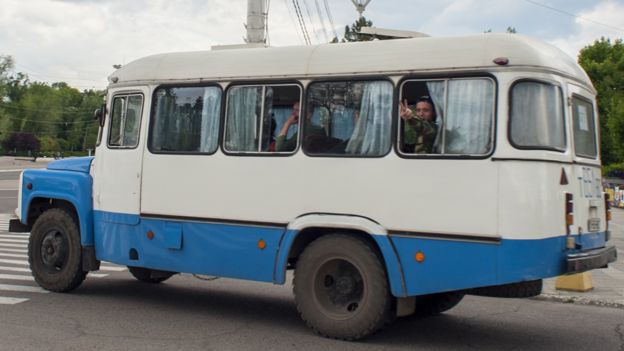
Image copyrightGETTY IMAGESImage captionSoldiers travel by bus through Tiraspol, the capital of Trans-Dniester
At the other end of the scale, the Islamic State group proclaimed a state straddling Syria and Iraq which existed for three years, but was never recognised by any countries.
Abkhazia, Trans-Dniester (also known as Transdniestria or Transnistria) and northern Cyprus are somewhere in the middle. All three emerged out of conflicts which remain unresolved.
The breakaway region of Abkhazia won a war of secession with Georgia in 1992-93 and declared independence in 1999. In 2008, it was recognised by Russia - which Georgia considers an occupying force - and a handful of other states.
Turkish Cypriots declared a state even earlier, in 1983, nine years after the political crisis and conflict in which Turkey invaded the north of the island. The UN continues to patrol the dividing Green Line and reunification talks have never succeeded.
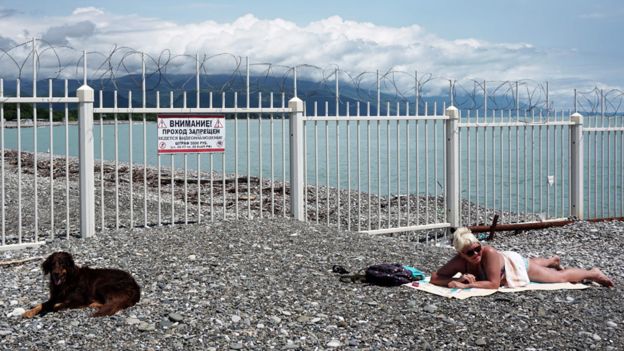
Image copyrightGETTY IMAGESImage captionA woman and her dog sunbathe next to the Black Sea border between Russia and Abkhazia
Each has a government and, although they are far from receiving international recognition, there is no sign of them collapsing.
This qualifies them as "de facto states" - places that govern their own territory, but which are outside the international system.
Importantly, all three of these breakaway territories have a powerful patron - Russia in the case of Abkhazia and Trans-Dniester, and Turkey in the case of northern Cyprus.
The patron helps them to survive - providing financial and military backing and stationing troops there.
But even if Russia or Turkey were to reduce support, these breakaway territories would not just melt away.
They would be weaker, but all would still retain a strong local identity and harbour aspirations to be separate.
Image copyrightGETTY IMAGESImage captionA Turkish Republic of Northern Cyprus flag painted on to a hillside in Nicosia, northern Cyprus
The international community does not think about these places very often - or the underlying problems that keep them in their strange state of limbo.
Interest in the de facto states is often from lovers of "places that don't exist", particularly in the cases of Abkhazia and Trans-Dniester.
Lack of formal recognition certainly leads to over-compensation in the production of state symbols.
They have developed quasi-state paraphernalia worthy of Freedonia - the Marx Brothers' fictitious state in Duck Soup - or the Republic of Zubrowka, from Wes Anderson's Grand Budapest Hotel.
Abkhazia prints exotic stamps with an eye on collectors around the world.
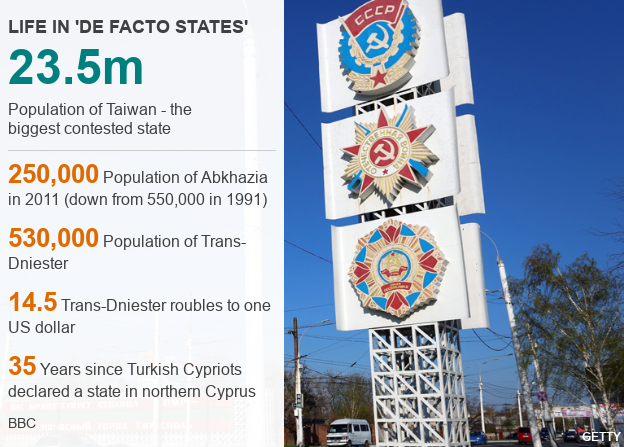
Trans-Dniester still has Soviet-era insignia on its symbols, such as the hammer and sickle. It prints its own currency, the Trans-Dniester rouble, which can only be used inside its borders.
Uniquely in the world it prints plastic coins in different shapes, which make them easily identifiable for blind people, and which fetch high prices on eBay.
Yet while they may be idiosyncratic, it is a stretch nowadays to call the trio "rogue states".
That is not to say they are without problems. Human trafficking, for example, is a big issue in both northern Cyprus and Trans-Dniester.
Yet the main impression a visitor to these places would have is of their ordinariness.
Image copyrightGETTY IMAGESImage captionA group of boys swimming at the Black Sea in Abkhazia
All have traffic lights, traffic police, hospitals and other trappings of more "normal" states.
Shoppers sit in cafes glancing at smartphones - even if the coffee they drink is not brewed by a global brand like Starbucks.
And despite their home state having almost zero prospect of wide international recognition, people have the same goals as those anywhere else.
Businesses want foreign trade, students want scholarships abroad.
The states follow many European norms voluntarily. None of them has the death penalty and all hold quite strongly competitive elections - even if the pool of candidates is quite limited.
Image copyrightGETTY IMAGESImage captionA group of men play Okey in Nicosia, northern Cyprus
However, a place cannot live by postage stamps alone - it needs to collect those tax revenues and to make sure the police force and school system work.
That gives the outside world and would-be conflict mediators some leverage and influence - something that is only being used to a limited extent at present.
Offers of help with education and health could be accompanied by calls for co-operation on the extradition of fugitives, for example.
To a degree that is already happening with Trans-Dniester, which has quietly signed up to Moldova's free trade agreement with the European Union.
It has also made an agreement that means cars from Trans-Dniester can travel abroad with neutral-looking number plates registered in Moldova. And diplomas from Trans-Dniester's main university can be registered internationally.
Visually the place may still look like a Soviet theme park, with its statues of Lenin and hammers and sickles, but it is actually moving in another direction.
As one former official said to me: "My head is in Russia, but my legs are moving towards Europe."
Image copyrightGETTY IMAGESImage captionYoung women at an ice cream stall in Trans-Dniester
With full resolution of these disputes still far off, this model of incremental change and international engagement offers an alternative way forward.
If the three territories will not be reintegrated into their parent states of Cyprus, Georgia and Moldova in the near future, at least their residents - but not their governments - could become part of the global community.
Without giving them recognition, de facto states can be more predictable and better aligned with their neighbours.
Over the longer term, the deep-rooted conflicts that created these de facto states could be a little bit easier to overcome.
Just do not hold your breath. They promise to be around for a long time to come.

:max_bytes(150000):strip_icc():format(webp)/freuds-stages-of-psychosexual-development-2795962-5b61cd3dc9e77c007be4124d.png)